Velotric Breeze 1
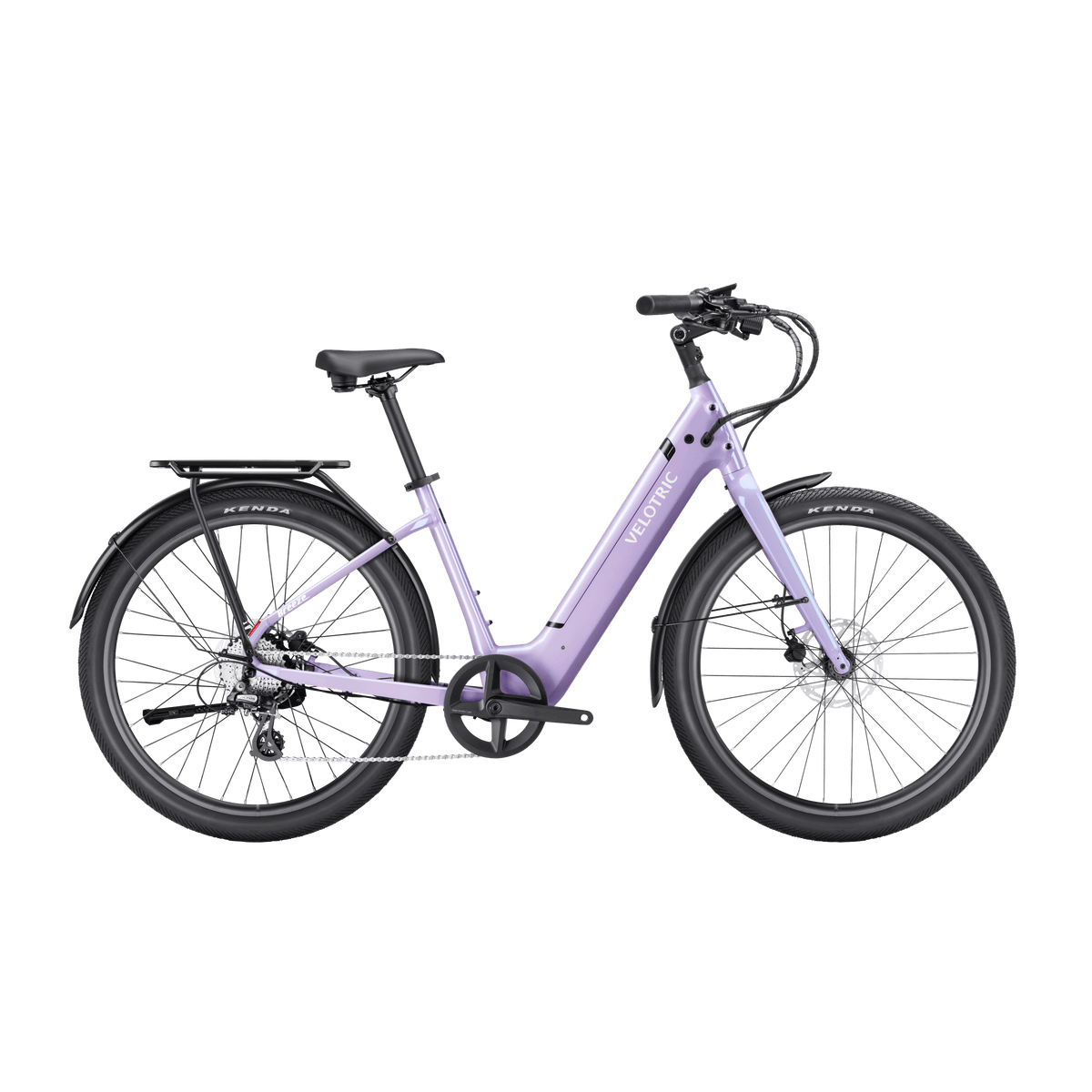
Velotric Breeze 1
Where it wins
- Genuinely comfortable upright ride
- Clean cruiser styling
- App-free basic operation
Where it doesn't
- Not built for hills at speed
- Single frame size
The Velotric Breeze 1 attacks the biggest problem with affordable e-bikes — they’re tanks — by delivering a 750W motor and a 627Wh battery in a package right around 50 lbs. On paper, that combination barely exists at its $1,799 price: most cruisers with this much power weigh 65–75 lbs, and most bikes this light give up power or range. If your riding is pavement and boardwalk rather than trail, this is arguably the smartest bike in Velotric’s lineup.
Who it’s for
The Breeze 1 fits riders who want an easy, upright, comfortable ride and who feel the weight of a bike every day: apartment dwellers who carry bikes up steps, anyone lifting onto a car rack, smaller riders who find 70 lb e-bikes intimidating to walk and park, and returning cyclists who want pedaling to feel like cycling rather than piloting. The step-thru frame with a low 15″ standover, Dutch-style bars, and a sprung saddle set an unmistakably relaxed posture, and the two frame sizes cover roughly 4’11” to 6’4″.
It’s not for off-roaders — there’s no suspension, and the 27.5×2.2″ tires are street rubber — and its 330 lb payload, while adequate for most, is far below the Nomad 2X’s 560 lbs, so heavy riders hauling heavy cargo should look elsewhere.
Key specs
| Spec | Velotric Breeze 1 |
|---|---|
| Motor | 750W rear hub, 1,150W peak, 65 Nm torque |
| Battery | 48V, 13.4Ah (627Wh), UL 2271, IPX7, ~7.9 lbs |
| Range | Up to 70 mi claimed; ~36–74 mi across independent test conditions |
| Top speed / class | Class 2 out of the box (20 mph), unlockable to Class 3 (28 mph) |
| Brakes | Tektro 2-piston hydraulic disc, 180mm rotors |
| Drivetrain | Shimano Altus 8-speed, 46T chainring, 11-32T cassette |
| Weight / payload | ~50 lbs with battery / 330 lbs |
| Display | 3.5″ color LCD, Bluetooth, USB-C, turn signals, Apple Find My |
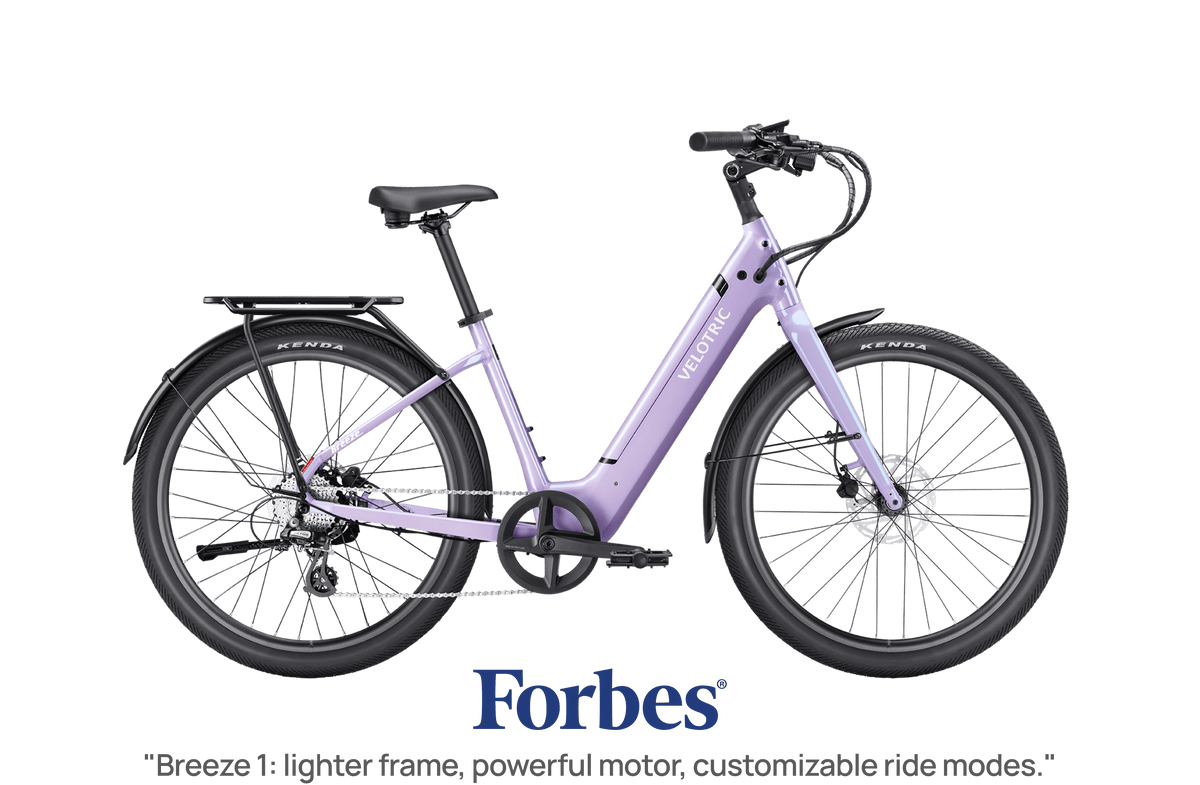
Living with it
The weight advantage compounds in daily life. At about 50 lbs — and roughly 42 with the battery out — the Breeze 1 sits at the edge of what one adult can carry up a short flight of stairs and comfortably within what standard hitch racks and even some trunk racks can handle. That alone widens where the bike can live: a hallway, a first-floor closet, a car trunk with the wheel off, rather than only a garage.
The 7.9 lb battery pops out for indoor charging on the included 3-amp charger; based on the pack size, a full charge from empty should take roughly 4.5 hours. Practical range planning from published test figures: mid-30s miles if you cruise fast at high assist, up toward 60–70 miles at gentle assist levels. For a 10-mile round-trip commute, that’s a charge every week or so.
Comfort comes from geometry and touchpoints — swept bars, ergonomic grips, spring saddle — rather than suspension, which is the right trade for a lightweight bike but means you’ll feel broken pavement through the fork. Running the 2.2″ tires toward the lower end of their pressure range softens things noticeably. Maintenance is minimal: hydraulic brakes need pads occasionally, the 8-speed drivetrain is corner-bike-shop simple, and there are no suspension pivots or air pressures to service. The tech layer — turn signals, cruise control, motor temperature monitoring, Apple Find My for theft tracking — is unusually complete for a cruiser under $2,000.
Cost of ownership
Velotric backs the Breeze 1 with its 2-year warranty on electrical components, including the motor and battery — a real differentiator, since several rivals in this price class still offer one year. The battery is UL 2271 certified, which matters both for safe indoor charging and increasingly for apartment-building and insurance requirements. A replacement pack should run several hundred dollars (plan on roughly $400–$500 for this capacity class), likely 3–5 years out for a typical rider given normal charge-cycle life.
Running costs are among the lowest in Velotric’s range: standard-size street tires are cheap and long-wearing, the lighter bike is easier on brake pads than the 80 lb Nomad 2X, and electricity for a full charge costs pennies. Budget for a basic tune-up in the first few hundred miles (spoke tension, brake bedding, shifting adjustment) as with any direct-to-consumer bike.
How it compares
Inside the Velotric family, the Breeze 1 is the pavement specialist. The Nomad 2X costs $600 more and brings full air suspension, fat tires, and a 560 lb payload — worth it only if you genuinely ride rough terrain, because you pay for it with 30 extra pounds. The Triker serves riders who need three-wheel stability and cargo capacity and accept ~98 lbs of vehicle in exchange. If you can balance a bike and stay mostly on pavement, the Breeze 1 beats both on price, weight, and everyday usability.
Against the broader market, the Aventon Pace is the closest rival — similarly upright and torque-sensor equipped, competitively priced, but generally heavier for equivalent power. Budget cruisers like the Ride1Up Turris undercut the Breeze 1 by several hundred dollars but typically with smaller batteries, cadence-only sensors, and shorter warranties. Premium lightweight cruisers (Electra’s Go! line and similar) match the weight but at notably higher prices with smaller motors. The Breeze 1’s pitch — full 750W power, big-brand feature set, ~50 lbs, under $1,800 — is a combination few competitors match on paper.
FAQ/h2>
How much does the Velotric Breeze 1 weigh?
About 50 lbs with the battery installed, and roughly 42 lbs with the 7.9 lb battery removed. That’s 15–25 lbs lighter than most 750W cruiser e-bikes, and it’s the single biggest reason to choose this bike — it changes how you store, transport, and handle it every day.
Is the Breeze 1 a Class 2 or Class 3 e-bike?
It ships as a Class 2 (20 mph, pedal assist plus throttle) and can be unlocked to Class 3 speeds up to 28 mph via the display or app. Throttle operation remains a 20 mph function; check local rules, since Class 3 bikes are restricted on some multi-use paths.
What is the real-world range of the Breeze 1?
Velotric claims up to 70 miles. Independent testing spanned roughly 36 miles (fast, high-assist riding) to 74 miles (low assist). A practical planning figure for mixed riding at moderate assist is 40–55 miles; cold weather, hills, and heavier riders will trim that.
Bottom line
The Breeze 1 is the easiest Velotric to recommend to the most people: full power and real range in a bike light enough to live with, wrapped in a feature set — hydraulic brakes, torque sensing, turn signals, Find My, 2-year warranty — that reads a class above its $1,799 price. Buy it if you ride pavement, value low weight, and want a comfortable upright cruiser that doesn’t feel like a compromise. Skip it if you need suspension for rough surfaces, a payload above 330 lbs, or three-wheel stability — the Nomad 2X and Triker exist for exactly those riders. As a first e-bike or a downsizing move from a heavier one, it’s a standout.